Bringing MIT-Haiti closer to its readers
- Web Development
- Development
- Digital Strategy
- Technical Consulting
- Support
(01)Overview
A proposal to bring the site closer to the people it serves
This is a proposal to move mit-ayiti.net to a faster, more reliable home and to store ready-to-load copies of the site on servers near Haiti — without changing a single feature visitors use.
Submissions, profiles, the podcast, the resource library, and search all keep working exactly as they do today. The change is underneath: a modern hosting platform, a global delivery network that puts the site closer to readers in Haiti, and a workflow that lets the team try changes safely before visitors ever see them.
(02)Today
What's holding the site back
The site runs on Dreamhost shared hosting in the United States. That setup has served MIT-Haiti for years, but it's now the main drag on speed, security, and the team's ability to ship changes with confidence.
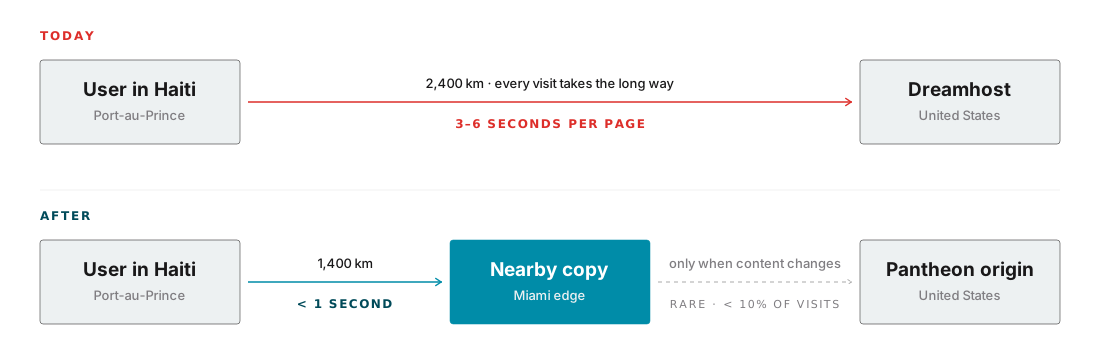
- Everything lives on one US server. Every time someone in Haiti visits the site, the page has to travel roughly 2,400 km from the US and back. There's no copy stored closer to home, so every visit takes the long way around.
- Changes go straight to the live site. There's no practice space to try changes safely before visitors see them. If an update breaks something, the broken version goes live first — visitors are effectively the test.
- Outdated software. WordPress and its add-ons are years behind their current versions. Each older version has known security weaknesses that newer versions have already fixed.
- Too many add-ons. Several add-ons doing overlapping jobs — including an old newsletter tool the team has already replaced with Mailchimp. More moving parts means more things that can break.
- Manual upkeep. Backups, security certificates, software updates, server maintenance — all done by hand. When something breaks at 2 a.m., it's the team's problem to fix.
- No way to measure Haiti speeds. There are no tools in place to track how the site actually performs for visitors in Haiti. No real answer to "how fast is this for someone in Port-au-Prince right now?"
(03)After Migration
What Pantheon brings
Pantheon is a managed hosting platform built specifically for WordPress and Drupal. We've been a Pantheon partner for more than a decade. The move addresses every issue above and pushes the ongoing maintenance burden off the team.
- A worldwide network of nearby servers. Pantheon includes a network of 70+ servers around the world that hold ready-to-load copies of the site. The nearest one to Haiti is in Miami — about 1,400 km away, roughly half the current distance.
- A safer way to publish changes. Three separate copies of the site: one for building, one for testing, and one for visitors. Changes get tried out and reviewed in the first two before they ever reach the live site.
- Up-to-date software. Current versions of WordPress and the software it runs on. Faster, more secure, and compatible with modern add-ons for years to come.
- Fewer, better add-ons. Two or three unused add-ons removed during the move. The rest updated to current versions. Less to break, less to maintain, faster pages overall.
- Pantheon handles the upkeep. Automatic backups, free security certificates, software updates, server maintenance, and protection against malicious traffic — all handled by Pantheon, not by the team.
- Clear visibility into performance. Pantheon's dashboard shows traffic, response times, and how often the nearby copy is being used — all in real time. Easy to see how the site is doing, including for visitors in Haiti.
(04)Performance
The numbers Haiti will feel
Three measurements that change for a visitor in Port-au-Prince the day the site moves:
- Distance to nearest server
- From 2,400 km to 1,400 km — Port-au-Prince to the nearest copy of the site, in Miami.
- Time to start loading
- From ~120 ms to ~30 ms — how long before the page starts to appear. Roughly four times faster.
- Full page load
- From 3–6 seconds to under one second — how long a typical page takes to fully appear for a visitor in Haiti.
Visually, the difference is the introduction of a "nearby copy" in Miami that handles the great majority of visits — the Pantheon origin in the US is only contacted when content changes.
(05)The Process
Four phases, about four to six weeks
The migration runs in four phases. The original site keeps serving visitors as normal until the very last step, when we point the domain at the new home at a scheduled, low-traffic time.
- 01 · Copy
- A complete copy of the site is built on the new platform. The original keeps running as normal — visitors won't see anything change yet. Roughly one week.
- 02 · Update
- On the copy, WordPress and its add-ons get updated to current versions. Unused add-ons are removed. The live site stays untouched. Roughly one to two weeks.
- 03 · Test
- Every feature gets tested — registration, submissions, profiles, the podcast, search — to make sure nothing broke. Any issues are fixed before launch. Roughly one to two weeks.
- 04 · Cut over
- At a chosen low-traffic time, the website's address is updated to point at the new platform. Within hours, visitors land on Pantheon — and feel the speed. Scheduled, takes about a day.
(06)The Cost
Free — with one condition
A migration like this would normally be a paid engagement. We'd like to do it for MIT-Haiti at no cost — in exchange for permission to document the work and share the story across all our marketing.
- For MIT-Haiti
- A modernized, faster, more reliable site at no cost. Full ownership of the site and its content stays with you. No invoice arrives.
- For our team
- A documented case study and talking points to share across our marketing. Visible work in the public-interest education sector.
- For Pantheon
- A real-world case study to point to: their platform serving a public-good initiative reaching educators and learners across Haiti.
(07)Looking Ahead
Possibilities for after the migration
The migration is the foundation. Once it's in place, a few things become possible that are awkward or expensive on the current setup. None of these are part of the migration scope — they're conversations to have once the site is on solid ground.
- Write content in tools you already use. Today, all site content has to be written and edited inside WordPress. We could connect the site to Google Docs or Microsoft 365 so contributors draft content in familiar tools, and finished drafts publish to the site directly. Lower friction for occasional contributors, easier workflows for everyone.
- A richer community experience. The current community features — accounts, profiles, favorites, submissions — work well for what they do. Beyond the migration: discussions around resources, alerts when new content matches a contributor's interests, and clearer recognition for active members. We can shape this together once the foundation is solid.
(08)What Doesn't Change
Every feature stays, every link keeps working
Submissions, profiles, the podcast, the resource library, and search all work exactly as they do today. Visitors won't notice anything has changed — except that pages load much faster.
The site just gets faster, safer, and easier to look after.