Helping Haitian Teachers Share Classroom Materials
- Web Development
- Technical Consulting
- Next.js
- Pantheon

(01)The Challenge
Classroom materials in the language students actually speak
The Platform Ayiti project provides classroom material in Haitian Creole for all ages and all subjects, created by Haitian teachers, for Haitian teachers. In Haiti, the official language for schools is French. But virtually 100% of the population speaks Haitian Creole as their native language, and it is a part of the cultural identity.
Platform Ayiti gives teachers a place to share resources and collaborate. Most teachers reach it on a phone over mobile data. So the site has to be fast on a slow connection, and teachers need to find the right material quickly.
(02)The Solution
A teaching library with an assistant that speaks your language
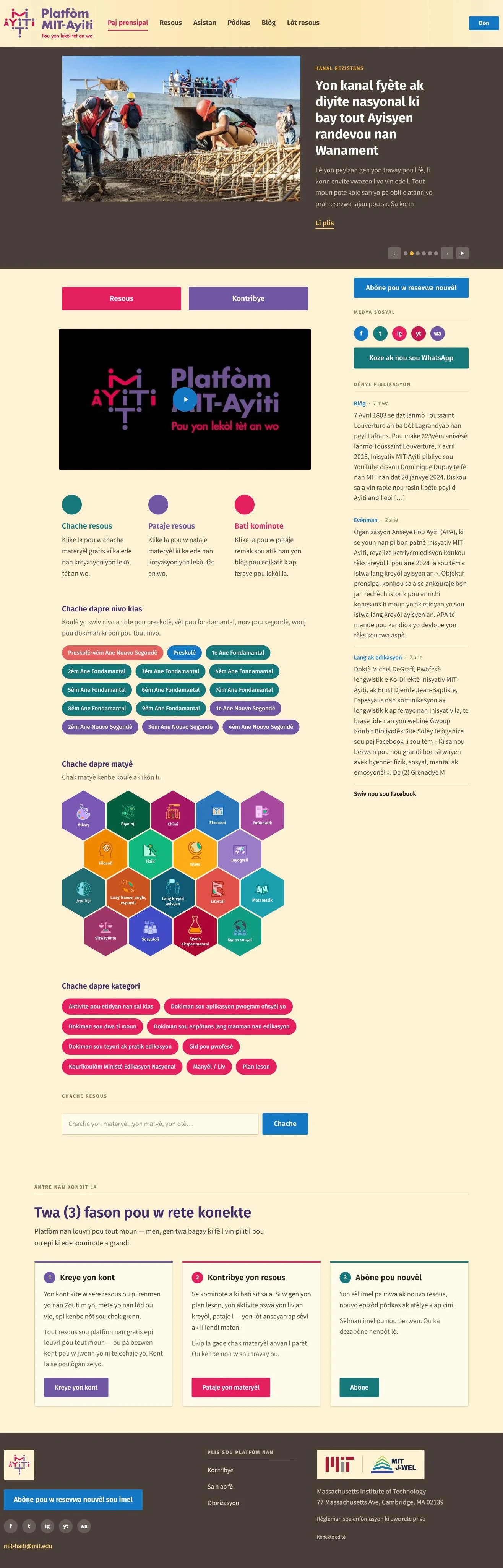
We built Platform Ayiti as a teaching library, not just a publishing site. Teachers can do more than find materials. They curate their favorite sources into lists and share those lists with other teachers. We wanted it to be really, really fast on the connections teachers actually have. Pages load quickly over mobile data, and anything a teacher saves stays on their phone, so it still works when the connection drops.
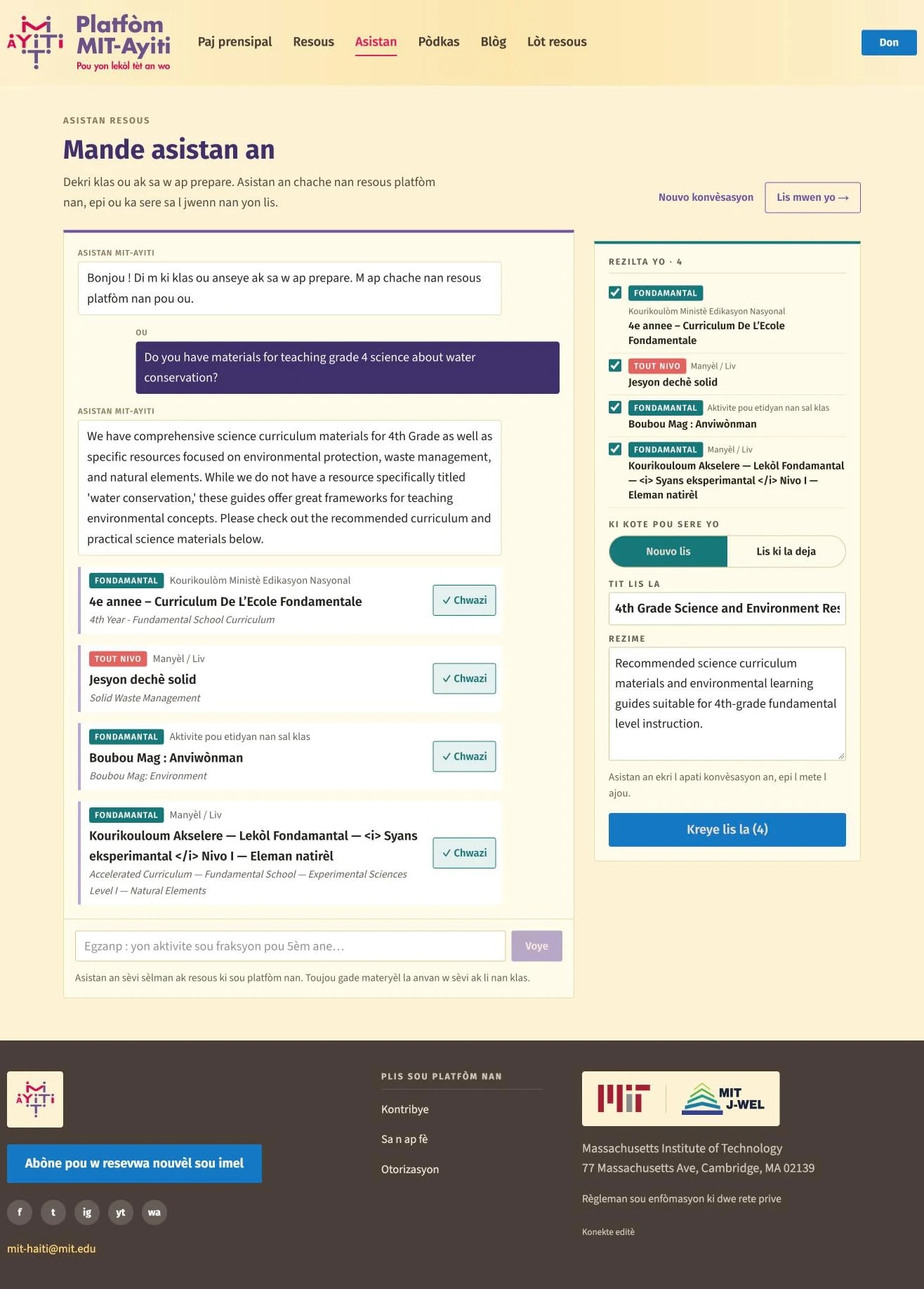
The heart of the new platform is Asistan (Kreyòl for "assistant"). A teacher asks for what they need in plain words. For example: "Do you have materials for teaching grade 4 science about water conservation?" Asistan answers with a list of matching resources from the library, and the teacher can save them straight into a list.
Teachers can ask in Haitian Creole, French, English or any of about 140 other languages. Asistan works out the language of the question and answers in the same language. That supports teachers who want to work in Haitian Creole, and it welcomes French and English speakers too. When nothing in the library matches, Asistan asks follow-up questions and suggests other resources that could help.
Asistan stays inside the library. It only answers about content on the site, or content the site links to or references. It does not generate teaching materials, and it never recommends anything outside the library. Every answer points a teacher to real material made by other teachers.
(03)Behind the Curtain
Built to be fast for teachers and easy for editors
Every page on Platform Ayiti is built ahead of time with Next.js and served from a CDN close to the reader. The server does the heavy lifting, so phones download as little JavaScript as possible. That is what keeps pages quick over mobile data.
The people who run the site edit it in Pantheon P1. It holds the content and media, and gives editors a visual page editor built on the open-source Puck editor and Tiptap. Editors see the page they are building as they build it.
Teacher accounts live in Google Cloud, using Firebase for sign-in and identity. Each teacher's preferences and saved lists are stored there too, and cached on their device so the lists still work offline. Teachers reorder lists with up and down arrows instead of dragging, so keyboard and screen-reader users can manage them as well.
Asistan runs on Google Vertex AI. We index all of the site's content and give it to the model as context. That is what keeps its answers inside the library. Search works the same way on a smaller scale: a compact index filtered in the browser, with every result a page search engines can crawl.
We also used AI in our own process. It helped us audit the content structure to shape the content model, and it helped us build repeatable Playwright test suites.
(04)The Result
Fast on any connection, useful even without one
Most teachers reach Platform Ayiti on a phone over mobile data, so we tested it the way they use it. We compared four pages on the old site and the new one with Google Lighthouse, under a simulated Haitian mobile connection of 7 Mbps with 100 ms of latency. Every page got faster. The home page now shows its first content in 0.73 seconds, down from 1.59, and the server starts responding in 0.07 seconds instead of nearly a full second. Pages are lighter too. The home page dropped from 2.5 MB to 1.0 MB, and the blog index went from 6.1 MB to under 1 MB. On mobile data, every megabyte a teacher doesn't download counts.
The rebuild also made the library easier to find. Every page we tested now scores 100 for SEO in Lighthouse, up from the low to mid 80s, and accessibility scores rose on every page.
Speed only helps when there is a connection, and in Haiti that isn't a given. Platform Ayiti is a progressive web application, so it keeps working when the signal drops. A teacher's saved materials and lists are stored on their device, so they can open them in the classroom with limited or no internet access.
The platform does more for teachers than it used to. Asistan answers in the teacher's own language and points them to materials that fit their lesson. Teachers save what they find into lists, then share those lists with colleagues, so a good unit plan can travel from one classroom to the next.
The full figures and method are in the overview report and the technical report.
Build the library around the teacher, not the content.